SelfDefinition.Org
Awareness Watching Awareness
Mirror Site for "Awareness" pages, originally published on Tripod.
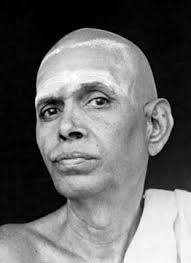
The Technique of Self-Inquiry by Sri Sadhu Om
Chapter 8 from The Path of Sri Ramana, Part One
Application of the principles of Self-inquiry outlined in Self Inquiry by Sri Sadhu Om here: sadhu-om-self-inquiry.htm
At the young age of sixteen, when He was not even aware of the fact 'This is the spiritual practice of Self-inquiry that directly bestows the experience of the Self', it so happened one day that, without any prior intention, Sri Ramana embarked upon this rare spiritual practice!
On that day as if He were about to die, a great fear of death possessed Him all of a sudden. Because of it, an impulse to scrutinize death also arose in Him spontaneously. He was not perturbed to see the fast-approaching death, nor did He feel inclined to inform others about it! He decided to welcome it calmly and to solve the problem all alone. He lay down, stretching His limbs like a corpse, and began to scrutinize death practically, face to face.
Since it is of prime importance for the readers to know the technique of Self-inquiry performed by Sri Ramana, the True Teacher, let us see it here in the very words in which he later narrated His experience.
"All right, death has come! What is death? What is it that is dying? It is this body that is dying; let it die!' Deciding thus, closing the lips tightly and remaining without breath or speech like a corpse, what came to my knowledge as I looked within was: 'This body is dead. Now it will be taken to the cremation ground and burnt; it will become ashes. All right, but with the destruction of this body, am I also destroyed? Am I really this body?
Although this body is lying as a speechless and breathless corpse, undoubtedly I am existing, untouched by this death! My existence is shining clearly and unobstructed! So this perishable body is not 'I'! I am verily the immortal 'I' (Self)! Of all things, I alone am the reality! This body is subject to death; but I who transcend the body am eternally living!' Even the death that came to the body was unable to touch me!
Thus it dawned directly, and along with it the fear of death that had come at first also vanished, never to appear again! All this was experienced in a split second as direct knowledge and not as mere reasoning thoughts. From that time onwards, the consciousness of my existence transcending the body has ever continued to remain the same."
Although Sri Ramana explained all this to us in so many words, He emphasized the all-important fact: 'All this took place within a second as a direct experience, without the action of mind and speech'.
On account of this fear of death, the concentration of Sri Ramana was fixed and deeply immersed in Self-attention in order to find out 'What is my existence? What is it that dies?'.
Thus it is proved by what Sri Ramana Himself did that, as we have been explaining all along, only such a firm fixing of our attention on Self is 'Self-inquiry'. He has confirmed the same idea in the work 'Who am I?', where He says:
"Always keeping the mind (the attention) fixed in the Self (in the feeling 'I') alone is called 'Self-inquiry' ... Remaining firmly in Self-abidance, without giving even the least room to the rising of any thought other than the thought of Self (that is, without giving even the least attention to any second or third person, but only to Self), is surrendering oneself to God (which alone is called the supreme devotion)."
When Sri Ramana was asked, 'What is the means and technique to hold constantly on to the 'I'-consciousness?', He revealed in His works the technique of Self-inquiry which, as explained above, He had undertaken in His early age, but in a more detailed manner as follows:
"Self (atman) is that which is self-shining in the form 'I am that I am'. One should not imagine it to be anything such as this or that (light or sound). Imagining or thinking thus is itself bondage. Since the Self is the consciousness which is neither light nor darkness, let It not be imagined as a light of any kind. That thought itself would be a bondage. The annihilation of the ego (the primal thought) alone is liberation.
All the three bodies consisting of the five sheaths are contained in the feeling 'I am the body'; therefore if, by the inquiry 'Who is this I'? (that is, by Self-attention), the identification with (attachment to) the gross body alone is removed, the identification with the other two bodies will automatically cease to exist.
As it is only by clinging to this that the identifications with the subtle and casual bodies live, there is no need to annihilate these identifications separately. How to inquire? Can this body, which is insentient like a log and such things, shine and function as 'I'? It cannot. The body cannot say 'I'."
– Forty verses on Reality, verse 23 by Sri Ramana. [1]
[1. The quotes attributed to "The Forty Verses on Reality" on this page are different from those in the document by the same name reproduced here: ramana-40-verses-on-reality.htm ]
- - -
"Discarding the body as a corpse, not uttering the word 'I' by mouth, but seeking with the mind diving inwards 'Whence does this I rise?' alone is the path to knowledge."
– Forty Verses, verse 29.
- - -
"If keenly observed what that feeling is which now shines as 'I', an experience of a new, clear and fresh knowledge of one's existence alone will be experienced without sound as 'I-I' in the heart.
"When the mind reaches the Heart by inquiring within 'Who am I?', he, 'I' (the ego) falling down abashed, the One (the Reality) appears spontaneously as 'I-I' (I am that I am)."
– Forty verses, verse 30.
- - -
"When sought within 'What is the place from which it rises as I?', 'I' (the ego) will die. This is Self-inquiry."
– Forty verses, verse 19.
- - -
"Where this 'I' dies, there and then shines forth spontaneously the One as 'I-I'. That alone is the Whole."
– Forty verses, verse 20.
If without leaving it we just be, the experience of a new, clear and fresh knowledge of one's existence, completely annihilating the feeling of individuality – the ego , 'I am the body' - finally will come to an end just as the camphor flame dies out. This alone is proclaimed to be liberation by Sages and scriptures.
Although in the beginning, on account of the tendencies towards sense-objects which have been recurring down the ages, thoughts rise in countless numbers like the waves of the ocean, they will all perish as the aforesaid Self-attention becomes more and more intense. Since even the doubt 'Is it possible to destroy all of them and to remain as Self alone?' is only a thought, without giving room even to that thought, one should persistently cling fast to Self-attention.
However great a sinner one may be, if, not lamenting 'Oh, I am a sinner! How can I attain salvation?' but completely giving up even the thought that one is a sinner, one is steadfast in Self-attention, one will surely be saved. Therefore everyone, diving deep within himself with desirelessness, can attain the pearl of Self.
As long as there are tendencies towards sense-objects in the mind, (since they will always create some subtle or gross world appearance) so long the inquiry 'Who am I?' is necessary. As and when thoughts rise of their own accord, one should annihilate all of them through inquiry then and there in their very place of origin.
What is the means to annihilate them? If other thoughts rise disturbing Self-attention, one should, without attempting to complete them, inquire 'To whom did they arise?'. It will then be known 'To me'; immediately, if we observe 'Who is this I that thinks?', the mind (our power of attention which was hitherto engaged in thinking of second and third persons) will turn back to its source (Self). Hence (since no one is there to attend to them), the other thoughts which had risen will also subside.
By repeatedly practicing thus, the power of the mind to abide in its source increases. When the mind thus abides in the Heart, the first thought, 'I' ('I am the body', the rising 'I'), which is the root of all other thoughts, itself having vanished, the ever existing Self (the being 'I') alone will shine. The place (or state) where even the slightest trace of the thought 'I' ('I am this, that, the body, the Self and so on') does not exist, alone is Self.
That alone is called Silence.
After coming to know that the final decision of all the scriptures is that such destruction of the mind alone is liberation, to read scriptures unlimitedly is fruitless. In order to destroy the mind, it is necessary to inquire who one is; then how, instead of inquiring thus within oneself, can one know oneself by inquiring in scriptures?
For Rama to know himself to be Rama, is a mirror necessary? (That is to say, for one to know oneself through Self-attention to be 'I am', are scriptures necessary?) 'Oneself' is within the five sheaths, whereas the scriptures are outside them. Therefore, how can oneself, who is to be attended to within, setting aside even the five sheaths, be found in scriptures? Since scripture inquiry is futile, one should give it up and take to Self-inquiry. – Thus says Sri Ramana.
The above several paragraphs were paraphrased from the first chapter of 'Vichara Sangraham' and from the whole of 'Who am I?', both by Ramana Maharshi.
* * *
By means of an example, let us make clear this technique of fixing the attention only on the Self, which has been described above in the words of Sri Ramana. But from the very outset it must be conceded that, since the nature of Self is unique and beyond comparison, it cannot be explained fully and accurately by anyone through any example whatsoever.
Though most of the examples which have been given in accordance with the intellectual development of the people and the different circumstances of their times may be appropriate to a great extent, these insentient examples can never fully explain Self, which is sentient.
The example of a movie projector often pointed out by Sri Ramana and the following example of a reflected ray of the sun from a mirror are given solely with the view that they may remove many doubts of the readers and clarify their understanding. But one should not fall into the error of stretching the example too far.
A broken piece of mirror is lying on the ground in the open space in full sunshine. The sunlight that falls on that piece of mirror is reflected, and the reflected light enters a nearby dark room and falls on its inner wall. The ray from the mirror to the inside wall of the dark room is a reflected ray of the sun. By means of this reflected ray, a man in the dark room is able to see the objects inside that room.
The reflected light, when seen on the wall, is of the same form or shape as the piece of mirror (triangular, square or round). But the direct sunlight (the original light, the source of the reflected ray) in the open space shines indivisible, single, all-pervading and unlimited by any specific form or shape.
Self, our existence-consciousness, is similar to the direct sunlight in the open space. The ego-feeling or mind-knowledge, the 'I am the body'–consciousness, is similar to the reflected ray stretching from the mirror to the inner wall of the room. But since Self-consciousness is limitless like the vast, all-pervading direct sunlight, it has no form-adjunct.
Just as the reflected ray takes on the limitations and size of the piece of mirror, the ego-feeling experiences the size and form of a body as 'I': it has adjuncts. Just as objects in the dark room are cognized by means of the reflected light, the body and world are cognized only by means of the mind-knowledge.
"Although the world and the mind rise and set together, it is by the mind alone that the world shines."
‐ Forty Verses, verse 7.
Let us suppose that a man in the dark room wants to stop observing the objects in the room, which are seen by means of the reflected light, and is possessed instead by a longing to see its source, 'Whence comes this light?'. If so, he should go to the very spot where the reflected beam strikes the wall, position his eyes and look back along the beam.
What does he see then? The sun! But what he now sees is not the real sun; it is only a reflection of it! Furthermore , it will appear to him as if the sun is lying at a certain spot on the ground outside the room! The particular spot where the sun is seen lying outside can even be pointed out as being so many feet to the right or left of the room (like saying, 'Two digits to the right from the center of the chest is the heart').
But, does the sun really lie thus on the ground at that spot? No, that is only the place whence the reflected beam rises! What should he do if he wants to see the real sun? He must keep his eyes positioned along the straight line in which the reflected beam comes and, without moving them to either side of it, follow it towards the reflected sun, which is then visible to him.
Just as the man in the dark room, deciding to see the source of the reflected beam which has come into the room, gives up the desire either to enjoy or to make research about the things there with the help of that reflected beam, so a man who wants to know the real light (Self) must give up all efforts towards enjoying or knowing about the various worlds, which shine only by means of the mind-light functioning through the five senses.
He cannot know Self if he is deluded by cognizing and desiring external objects (like a worldly man) or if he is engaged in investigating them (like our modern scientists).
This giving up of attention towards external sense-objects is desirelessness or inward renunciation. The eagerness to see whence the reflected ray comes into the room corresponds to the eagerness to see whence the ego-'I', the mind-light, rises. This eagerness is love for Self.
Keeping the eyes positioned along the straight line of the beam without straying away to one side or the other corresponds to the one-pointed attention fixed unswervingly on the 'I'-consciousness. Is not the man now moving along the straight line of the reflected beam from the dark room towards the piece of mirror lying outside? This moving corresponds to diving within towards the Heart.
"Just as one would dive in order to find something that had fallen into the water, so one should dive within with a keen (introverted) mind, controlling breath and speech, and know the rising-place of the rising ego. Know thus!"
– Forty verses, verse 28
Some, taking only the words 'should dive within controlling breath and speech', set out to practice exercises of breath-control (pranayama). Although it is a fact that the breath stops in the course of inquiry, for it to be stopped the roundabout way of breath control (pranayama) is not necessary. When the mind, with a tremendous longing to find the source which gives it light, turns inwards, the breath stops automatically!
"Therefore, by the practice of fixing the mind (the attention) in the Heart (Self), the pure consciousness, both the destruction of tendencies-habits-predispositions and the control of the breath are accomplished automatically."
– Forty verses supplement, verse 24
If the breath of the inquirer is exhaled at the time of his mind thus giving up knowing external sense-objects and starting to attend to its original form of light, Self, it automatically remains outside without being again drawn in. Likewise, if it is inhaled at that time, it automatically remains inside without being again exhaled! These are to be taken as 'external retention' and 'internal retention' respectively. Until there is a rising of a thought on account of non-vigilance in Self-attention, this retention will continue in an inquirer quite effortlessly.
By a little scrutiny, will it not be clear to anyone that even in our every day life when some startling news is suddenly brought to us or when we try to recollect a forgotten thing with full concentration, the breath stops automatically on account of the keenness of mind (the intensity of concentration) that takes place then? Similarly, the breath will stop automatically as soon as the mind, with an intense longing to see its original form of light and with earnest one-pointedness, begins to turn keenly and remain within. In this state of retention, no matter how long it continues, the inquirer does not experience suffocation, that is, the urge to exhale or inhale.
But while practicing breath control, if the units of time of the retention are increased, one does experience suffocation. If the inquirer's attention is so intensely fixed on Self that de hoes not even care to know whether the breath has stopped or not, then his state of retention is involuntary and without struggle.
There are some aspirants, however, who try to know at that time whether or not the breath has stopped. This is wrong, since the attention will be lost and thereby various thoughts will shoot up and the flow of spiritual practice will be interrupted. That is why Sri Ramana advised, "Control breath and speech with a keen (introverted) mind'. It would be wise to understand this verse thus, by adding 'with a keen mind' in all the three places: Control the breath with a keen mind, dive within with a keen mind, and know the rising place with a keen mind.
By this very moving along with it, does not the man who positions his eyes on the reflected beam reduce its length? Just as the length of the beam decreases as he advances, so also the mind's tendency of expanding shrinks more and more as the aspirant perseveres in sincerely seeking its source.
"When the attention goes deeper and deeper within along the (reflected) ray 'I', its length decreases more and more, and when the ray 'I' dies, that which shines as 'I' is Self-Knowledge."
– Eleven Verses on Self-inquiry, verse 9 by Sri Sadhu Om.
When the man finally reaches very near to the piece of mirror, he can be said to have reached the very source of the reflected ray. This is similar to the aspirant diving within and reaching the source (Heart) whence he had risen. Does not the man now attain a state where the length of the reflected ray is reduced to nothing – a state where no reflection is possible because he is so close to the mirror?
Similarly, when the aspirant, on account of his diving deeper and deeper within by an intense effort of Self-attention, is so close to his source that not even an iota of rising of the ego is possible, he remains absorbed in the great dissolution of the 'I am the body'-feeling, which he had previously had as a target of attention. This dissolution is what Sri Ramana refers to when He says "'I' will die" in The Essence of Instruction, verse 19.
Because of his mere search for the source of the reflected ray of the sun, does not the man now, after leaving the dark room, stand in the open space in a state of void created by the non-existence of that reflected ray? This is the state of the aspirant remaining in the Heart-space in the state of the great void created, through mere Self-attention, by the non-existence of the ego-'I'. The man who has come out of the room into the open space is dazed and laments, "Alas! The sun that guided me so far (the reflected sun) is now lost."
At this moment, a friend of his standing in the open space comes to him with these words of solace: "Where were you all this time? Were you not in the dark room? Where are you now? Are you not in the open space? When you were in the dark room, that which guided you out was just one thin ray of light; but here (in this vast open space), are not the rays of light countless and in an unlimited mass? What you saw previously was not even the direct sunlight, but only a reflected ray! But what you are now experiencing is the direct sunlight. When the place where you are now is nothing but the unlimited space of light, can a darkness come into existence because of the void created by the disappearance of the reflected ray? Can its disappearance be a loss? Know that its disappearance itself is the true light; it is not darkness."
Similarly, by the experience of the great void, created by the annihilation of the ego, the aspirant is somewhat taken aback, "Alas! Even the 'I'-consciousness (the ego), which I was attending to in my spiritual practice till now as a beacon light, is lost! Then is there really no such thing at all as 'Self' (atman)?"
At that very moment, the True Teacher, who is ever shining as his Heart, points out to him thus: "Can the destruction of the ego, which is only an infinitesimal reflected consciousness, be really a loss? Are you not clearly aware not only of its former existence, but also of the present great void created by its disappearance? Therefore, know that you, who know even the void as 'this is a void', alone are the true knowledge; you are not a void!"
"True knowledge is being devoid of knowledge as well as ignorance of objects. Knowledge of objects is not true knowledge. Since the Self shines self-luminous, with nothing else for It to know, with nothing else to know It, the Self is Knowledge. It is not a void."
– Forty Verses, verse 12.
In an instant as a direct experience of the shining of his own existence-consciousness by touching (flashing as a manifestation) in Heart as Heart, the aspirant who started the search 'Whence am I?' or 'Who am I?' now attains the non-dual Self-knowledge, the true knowledge 'I am that I am', which is devoid of the limitations of a particular place or time.
Clinging to the consciousness 'I' and thereby acquiring a greater and greater intensity of concentration upon it, is diving deep within. Instead of thus diving within, many, thinking that they are engaged in Self-inquiry, sit down for hours together simply repeating mentally or vocally 'Who am I?' or 'Whence am I?'. There are others again who, when they sit for inquiry, face their thoughts and endlessly repeat mentally the following questions taught by Sri Ramana:
To whom do these thoughts arise? To me; who am I?", or sometimes they even wait for the next thought to come up so that they can fling these questions at it! Even this is futile! Did we sit to thus hold a court of inquiry, calling one thought after another! Is this the spiritual practice of diving within? Therefore, we should not remain watching 'What is the next thought?'.
Merely to keep on questioning in this manner is not Self-attention. Concerning those who thus merely float on the surface of thought-waves, keeping their mind on these questions instead of diving within by attending to the existence-consciousness with a keen mind, thereby controlling mind, breath and all the activities of the body and senses, Sri Ramana says:
"Compare him who asks himself 'Who am I?' and 'From which place am I?', though he himself exists all the while as the Self, to a drunken man who prattles 'Who am I?' and 'Where am I?' "
– Five Verses on the Self, verse 2.
And further, He asks:
"How to attain that state wherein 'I' does not rise – that state of egolessness (the great void) – unless (instead of floating like this) we seek the place whence 'I' rises? And unless we attain that (egolessness), how to abide in the state of Self, where 'We are That'? "
– Forty Verses, verse 27.
Therefore, all that we are to practice is to be still with the remembrance of the feeling 'I'. It is only when there is a slackness of vigilance during Self-attention that thoughts, which are an indication of it, will rise.
In other words, if thoughts rise it means that our Self-attention is lost. It is only as a contrivance to win back Self-attention from thought-attention that Sri Ramana advised us to ask 'To whom do these thoughts appear?'. Since the answer 'To me' is only a dative form of 'I', it will easily remind us of the nominative form, the feeling 'I'.
However, if we question 'Who thinks these thoughts?', since the nominative form, the feeling 'I' , is obtained as an answer, will not Self-attention which has been unnoticed, be regained directly? This regaining of Self-attention is actually being Self (that is, remaining or abiding as Self)! Such 'being' alone is the correct spiritual practice; spiritual practice is not doing, but being!
Some complain, 'When the very rising of the ego from sleep is so surreptitious as to elude our notice, how can we see whence it rises? It seems to be impossible!"
That is true because the mind's effort of attention is absent in sleep, since the mind itself is not at all there! As ordinary people are not acquainted with the knowledge of their 'being' but only with the knowledge of their 'doing' (that is, the knowledge of their making efforts), for such people it is impossible to know from sleep the rising of the ego from there.
Since the effort considered by them as necessary is absent in sleep, it is no wonder that they are unable to commence the inquiry from sleep itself! But, since the whole of the waking state is a mere sportive play of the ego and since the effort of the mind here is under the experience of everyone, at least in the waking state one can turn and attend to the pseudo 'I' shining in the form 'I am so-and-so'.
"Turning inwards, daily see yourself with an introverted look and It (the Reality) will be known' thus did you tell me, O my Arunachala!"
– The Marital Garland of Letters, verse 44 by Sri Ramana.
The inquiry begins only during the leisure hours of the waking state when one sits for practice. Just as a thing comes to our memory when its name is thought of, does not the first person feeling come to everyone's memory as soon as the name (pronoun) 'I' is thought of?
Although this first person feeling is only the ego, the pseudo 'I' consciousness, it does not matter. Having our attention withdrawn from second and third persons and clinging to the first person – that alone is spiritual practice. As soon as the attention turns towards the first person feeling, not only do other thoughts disappear, but also the first thought, the rising and expanding pseudo 'I' consciousness, itself begins contracting!
"When the mind, the ego, which wanders outside knowing only other objects (second and third persons) begins to attend to its own nature, all other objects will disappear and, by experiencing its true nature (Self), the pseudo 'I' will also die."
– The Garland of Guru's sayings, verse 193
Another translation of that same verse: "If the mind turned outward and distracted, starts observing its own being, Alienation ends, the vestige ego, merges in the light of true Awareness shining in the heart."
– verse 193
"If the fickle mind turns towards the first person, the first person (the ego) will become non-existent and That which really exists will then shine forth."
– Eleven Verses on Self-Inquiry, verse 6 by Sadhu Om.
This is the great revelation made by Sri Ramana and bestowed by Him as a priceless boon upon the world of spiritual aspirants in order to bring Vedanta easily under practical experience.
Just as a rubber ball gains greater and greater momentum while bouncing down the staircase, the more the concentration in clinging to the first person consciousness is intensified, the faster is the contraction of the first thought (the ego), till finally it merges in its source.
That which now merges thus is only the adjunct, the feeling 'so and so' which, at the moment of waking, came and mixed with the pure existence-consciousness, which was shinning in sleep as 'I am', to constitute the form of the ego, 'I am so-and-so', 'I am this' or 'I am that'.
That is, what has come and mixed now slips away. All that an aspirant can experience in the beginning of his practice is only the slipping away (subsidence) of the ego. Since the aspirant tracks down the ego from the waking state, where it is in full play, in the beginning it is possible for him to cognize only its removal. But to cognize its rising (how it rises and holds on to 'I am') from sleep will be more difficult for him at this stage.
When Self-attention is started from the waking consciousness 'I am so-and-so', since it is only the adjunct, the feeling 'so-and-so', that slips away (because it is merely non-existent, and unreal thing (the unreal dies and the Reality alone survives, the aspirant even now (when 'so-and-so' has dropped off) feels no loss to the consciousness 'I am' which he had experienced in the waking state.
Now he attains a state which is similar to the sleep he has experienced every day and which is devoid of all and everything (because, 'The ego is verily all –, since the whole universe, which is nothing but thoughts, is an expansion of the ego). But a great difference is now experienced by him between the sleep that, without his knowledge, has been coming and overwhelming him all these days due to the complete exhaustion of mind and body, and this sleep which is now voluntarily brought on and experienced by him with the full consciousness of the waking state. How?
"Because there is consciousness, this is not sleep, and because there is the absence of thoughts, it is not the waking state; it is therefore the existence-consciousness, the unbroken nature of the Auspicious One who destroys illusion. Without leaving it, abide in it with great love."
– From the Essence of Spiritual Practice by Sri Sadhu Om
Whenever the aspirant during the time of spiritual practice becomes extroverted from this voluntarily brought about sleep like state, he feels absolutely certain, 'I was not sleeping, but was all the while fully conscious of myself'.
Though his real aspect (existence-consciousness) is ever knowing without the least doubt its own existence in sleep as 'I am', whenever he becomes extroverted from every day sleep, since he (the mind) did not even once have the experience of continuing to know 'I am' from the waking state, he can only say 'I slept, I did not know myself at that time'.
The truth is this: since the state of his Self-existence, devoid of the adjunct 'so-and-so', is traced out and caught hold of in the voluntarily brought about sleep with the full consciousness continuing from the waking state, the knowledge that the pure existence-consciousness knows itself as 'I am' is clear in this sleep state. That is why the aspirant now says 'I did exist throughout, I did not sleep!'.
Prior to his spiritual practice, since he was throughout the waking state identifying as 'I' the mind, which is the form of the adjunct 'so-and-so', after waking up from the ordinary daily sleep, where the mind did not exist, this mind (the man) says 'I did not exist in sleep!'. That is all!
Those who experience many times this removal of the ego through practice, since they have an acquaintance with the experience of their pure existence-consciousness as 'I am' even after the removal of the ego, can minutely cognize, even at the moment of just waking up from sleep, how the adjunct 'so-and-so' comes and mixes. Those who do not have such strength of practice cannot cognize, from sleep itself, the ego at its place of rising.
The only thing that is easy for them is to find the ego's place of setting (which is also its place of rising) through the effort started from the waking state. In either case, the end and the achievement will be the same. When the attention is focused deeper and deeper within towards the feeling 'I am' and when the ego thereby shrinks more and more into nothingness, our power of attention becomes subtler than the subtlest atom and thereby grows sharper and brighter.
Hence, the strength of abidance will now be achieved to remain balanced between two states, that is, in a state after the end of sleep and before waking up, in other words, before being possessed by the first thought. Through this strength, the skill will now be gained by the aspirant to find out the adjunct 'so and so', which comes and mixes, to be a mere second person (that is, although it has hitherto been appearing as if it were the first person, it will now be clearly seen to be his mere shadow, non-Self, the primal sheath, a thing alien to him).
This is what Janaka, the royal Sage, meant when he said "I have found out the thief (the time of his coming – the time and place of the ego's rising) who has been ruining me all along; I will inflict the right punishment upon him".
Since the ego, which was acting till now as if it were the first person, is found to be a second person alien to us, the right punishment is to destroy it at its very place of rising (just as the reflected ray is destroyed at its place of rising) by clinging steadfastly to the real first person (the real import of the word 'I'), existence-consciousness, through the method of regaining Self-attention taught by Sri Ramana ('To whom? To me; who am I?').
"As you practice more and more abiding in this existence-consciousness (that is, remaining in the state between sleep and waking), the ordinary sleep which had previously been taking possession of you will melt away, and the waking which was full of sense knowledge will not creep in again. Therefore repeatedly and untiringly abide in it."
– The Essence of Spiritual Practice by Sri Sadhu Om
By greater and more steadfast practice of abiding in this existence-consciousness, we will experience that this state seems to come often and take possession of us of its own accord whenever we are free from our daily work. Since this state of existence-consciousness is in fact nothing but 'we', it is wrong to think that such a state comes and takes possession of us! While at work, we attend to other things; after that work is over and before we attend to some other second or third person, we naturally abide in our real state, existence-consciousness.
Though this happens to one and all every day, it is only to those who have the experience of Self-consciousness through the aforesaid practice that the state of Self-abidance will be clearly discerned after leaving one second person thought and before catching another one (that is, between two thoughts).
"Why has it been said (in the above two verses of 'The Essence of Spiritual Practice') that one ought to make effort repeatedly to be in that state (our existence-consciousness) and ought to abide in it with more and more love? Because, until all the tendencies-habits-predispositons which drive one out of it are completely exhausted, this state will seem to come and go. Hence the need for continued effort and love to abide in the Self.
"When, through this practice our state of existence-consciousness is experienced always as inescapably natural, then there will be no harm even if waking dream and sleep pass across. For those who are well established in the unending Self-consciousness, which pervades and transcends all these three so-called states (waking, dream and sleep), there is but one state, the Whole, the All, and that alone is real! This state, which is devoid even of the feeling 'I am making effort', is your natural state of being! Be!! "
– From The Essence of Spiritual Practice by Sri Sadhu Om.
Just as the man came out into the open space from the dark room by steadfastly holding on to and moving along the reflected ray, so the inquirer reaches the open space of Heart, coming out of the prison, the attachment to the body through the nerves, by assiduously holding on to the feeling 'I am'.
Let us now see how this process takes place in the body of an advanced inquirer.
Just on waking up from sleep, a consciousness 'I' shoots up like a flash of lightening from the Heart to the brain. From the brain it then spreads throughout the body along the nerves. This I-consciousness is like electrical energy. Its impetus or voltage is the force of attachment with which it identifies a body as 'I'. This consciousness, which spreads with such a tremendous impetus and speed all over the body as 'I', remains pure, having no adjunct attached to it, till it reaches the brain from the Heart.
Since its force of attachment is so great that the time taken by it to shoot up from the Heart to the brain is extremely short, one millionth of a second so to speak, ordinary people are unable to cognize it in its pure condition, devoid of any adjunct. This pure condition of the rising 'I'-consciousness is what was pointed out by Sri Ramana when He said:
"In the space between two states or two thoughts, the pure ego (the pure condition or true nature of the ego) is experienced."
– Maharshi's Gospel, Book One, chapter five, entitled 'Self and Ego'.
For this 'I'-consciousness that spreads from the brain at a tremendous speed throughout the body, the nerves are the transmission lines, like wires for electrical power. (How many they are is immaterial here). The mixing of the pure consciousness 'I am', after reaching the brain, with an adjunct as 'I am this, I am so-and-so, I am the body' is what is called bondage or the knot.
This knot has two forms: the knot of bondage to the nerves and the knot of attachment. The connection of this power, the 'I'-consciousness, with the gross nervous system is called 'the knot of bondage to the nerves', and its connection with the causal body, whose form is the latent tendencies, is called 'the knot of attachment'. The knot of bondage to the nerves pertains to the breath, while the knot of attachment pertains to the mind.
"Mind and breath, which have thought and action as their respective functions, are like two diverging branches of the trunk of a tree, but their root (the activating power) is one."
– The Essence of Instruction, verse 12 by Sri Ramana.
Since the source of the mind and the breath is one (the Heart), when the knot of attachment is severed by the annihilation of the mind through Self-inquiry, the knot of bondage to the nerves - is also severed. In raja yoga, after removing the knot of bondage to the nerves by means of breath-control, if the mind which is thus controlled is made to enter the Heart from the brain, since it reaches its source, then the knot of attachment is also severed.
"When the mind which has been subdued by breath-control is led (to the Heart) through the only path (the path of knowing Self), its form will die."
– The Essence of Instruction, verse 14 by Sri Ramana.
However, since the knot of attachment is the basic one, until and unless the destruction of attachment is effected by knowing Self, even when the knot of bondage to the nerves is temporarily removed in sleep, swoon, death or by the use of anesthetics, the knot of attachment remains unaffected in the form of tendencies-habits-predispositions, which constitute the causal body, and hence rebirths are inescapable.
This is why Sri Ramana insists that one reaching kashta-nirvikalpa-samadhi through raja yoga should not stop there (since it is only a temporary absorption of the mind), but that the mind so absorbed should be led to the Heart in order to attain sahaja-nirvikalpa-samadhi, which is the destruction of the mind and the destruction of the attachment to the body.
In the body of such a Self-realized One, the coursing of the 'I'-consciousness along the nerves, even after the destruction of the knot of attachment, is like the water on a lotus leaf or like a burnt rope, and thus it cannot cause bondage. Therefore the destruction of the knot of attachment is anyway indispensable for the attainment of the natural state, the state of the destruction of the tendencies-habits-predispositions.
The nerves are gross, but the consciousness-power that courses through them is subtle. The connection of the 'I-consciousness with the nerves is similar to that of the electrical power with the wires, that is, it is so unstable that it can be disconnected or connected in a second. Is it not an experience common to one and all that this connection is daily broken in sleep and effected in the waking state? When this connection is effected, body-consciousness rises, and when it is broken, body-consciousness is lost.
Here it is to be remembered what has already been stated, namely that body-consciousness and world-consciousness are one and the same. So, like our clothes and ornaments, which are daily removed and put on, this knot is alien to us, a transitory and false entity hanging loosely on us! This is what Sri Ramana referred to when He said:
"We can detach our self from what we are not"!
Disconnecting the knot in such a way that it will never again come into being is called by many names such as 'the cutting of the knot', 'the destruction of the mind', and so on. 'In such a way that it will never again come into being' means this: by attending to it (the ego) through the inquiry 'Does it in truth exist at present?' in order to find out whether it had ever really come into being, there takes place the dawn of knowledge, the real waking, where it is clearly and firmly known that no such knot has ever come into being, that no such ego has ever risen, that 'that which exists' alone ever exists, and that that which was existing as 'I am' is ever existing as 'I am'!
The attainment of this knowledge (Self-knowledge), the knowledge that the knot or bondage is at all times non-existent and has never risen, is the permanent disconnecting of the knot. Let us explain this with a small story:
"Alas! I am imprisoned! I have been caught within this triangular room! How to free myself?" - thus was a man complaining and sobbing, standing in a corner where the ends of two walls joined. Groping on the two walls in front of him with his two hands, he was lamenting: "No doorway is available, nor even any kind of outlet for me to escape through! How can I get out?"
Another man, a friend of his who was standing at a distance in the open, heard the lamenting, turned in that direction and noticed the state of his friend. There were only two walls in that open space. They were closing only two sides, one end of each of them meeting the other. The friend in the open quickly realized that the man, who was standing facing only the two walls in front of him, had concluded, due to the wrong notion that there was a third wall behind him, that he was imprisoned within a three-walled room.
So he asked, 'Why are you lamenting, groping on the walls?"
"I am searching for a way through which to escape from the prison of this triangular room, but I don't find any way out!" replied the man.
The friend: "Well, why don't you search for a way out on the third wall behind you!"
The man (turning and looking): "Ah, here there is no obstacle! Let me run through this way." (So saying, he started to run away).
The friend: "What! Why do you run away? Is it necessary for you to do so? If you do not run away, will you remain in prison?"
The man: "Oh! yes, yes,! I was not at all imprisoned! How could I have been imprisoned when there was no wall behind me? It was merely my own delusion that I was imprisoned. I was never imprisoned, nor am I now released! So I do not even need to run away from near these walls where I am now! The defect of my not looking behind was the reason for my so-called bondage; and the turning of my attention behind is really the spiritual practice for my so-called liberation! In reality, I am ever remaining as I am, without any imprisonment or release!"
Thus knowing the truth, he remained quiet.
The two walls in the story signify the second and third persons. The first person is the third wall said to be behind the man. There is no way at all to liberation by means of second and third person attention.
Only by the first person attention 'Who am I?' will the right knowledge be gained that the ego, the first person, is ever non-existent, and only when the first person is thus annihilated will the truth be realized that bondage and liberation are false.
"So long as one thinks like a madman 'I am a bound one', thoughts of bondage and liberation will last. When looking into oneself 'Who is this bound one?', the eternally free and ever-shining Self alone will (be found to) exist. Thus, where the thought of bondage no longer stands, can the thought of liberation still endure!"
– Forty verses, verse 39.
(In the grammar of most languages, including Sanskrit, the first person, 'I', the second person, 'you', and the third person, 'he, she, it and so on', are each denominated as a person. But in Tamil grammar these three are termed respectively as the first place, second place and third place. Classifying them thus as places is a very helpful clue for aspirants. How? Is not the sole aim of sincere aspirants on the path to Reality to transcend illusion and to reach the Absolute, the Supreme Self? How then to cross or transcend illusion?
Time and place are the two foremost conceptions projected by illusion. Not even a single thought can be formed which is not bound up with illusion in the form of these two conceptions, time and place. Every thought must involve a past and future time (because each thought is formed in a moment of time, and each moment of time is merely a change from past to future) and must also involve an attention to a second or third person.
On the other hand, if one tries to form a thought of either the present time or the first person (that is, if one attends to either of these), all thoughts will cease – because the present out of the three times and the first person out of the three places are the root-conceptions, and the important characteristic of these two root-conceptions is that they will disappear, losing their existence, if they are sought for by being attended to.
Thus, when this primal time (the present) and primal place (the first person) lose their existence, even their source, illusion (maya which means 'that which does not exist'), itself vanishes, since it has no true existence of its own. This is the state transcending illusion and hence the ever-existing, one, whole and unlimited Self alone then shines!)
Just as we have explained the three walls as representing the three places, the first, second and third persons, we can also explain them as representing the three times, the present, past and future. Even though the attention to the present – avoiding all thoughts of past and future – in order to know what is the truth of the present, all thoughts will subside and the 'present' itself will vanish. How?
That which happened one moment before now is considered by us to be past, and that which will happen one moment from now is considered to be future. Therefore without paying attention to any time even one moment before or after this, if we try to know what that one moment is that exists now, then even one millionth of the so-called present moment will be found to be either past or future.
If even such subtlest past and future moments are also not attended to and if we try to know what is in-between these two, the past and future, we will find that nothing can be found as an exact present. Thus the conception of present time will disappear, being non-existent, and the Self-existence, which transcends time and place, alone will then survive.
"The past and future can exist only with reference to the present, which is daily experienced; they too, while occurring, were and will be the present. Therefore, (among the three times) the present alone exists. Trying to know the past and future without knowing the truth of the present (i.e. its non-existence) is like trying to count without (knowing the value of the unit) one!"
– Forty Verses, verse 15.
"When scrutinized, we – the ever-known existing Thing – alone are; then where is time and where is place? If we are (mistaken to be) the body, we shall be involved in time and place. But, are we the body? Since we are the One, now, then and ever, that One in space, here, there and everywhere, we – the timeless and spaceless Self – alone are!"
– Forty Verses, verse 16.
Hence, attending to the first place (the first person) among the three places or attending to the present time among the three times, is the only path to liberation. Even this, the path of Sri Ramana, is not really for the removal of bondage or the attainment of liberation! The path of Sri Ramana is paved solely for the purpose of our ever abiding in our eternal state of pure bliss, by giving up even the thought of liberation through the dawn of the right knowledge that we have never been in bondage.
"Only the first place or the present time, is advised to be attended to. If you keenly do so, you will enjoy the bliss of Self having completed all yogas and having achieved the supreme accomplishment. Know and feast on it!"
– The Essence of Spiritual Practice by Sri Sadhu Om.
Let us now again take up our original point. When the attention of an aspirant is turned towards second and third persons, the 'I'-consciousness spreads from the brain all over the body through the nerves in the form of the power of spreading; but when the same attention is focused on the first person, since it is used in an opposite direction, the 'I'-consciousness , instead of functioning in the form of the power of spreading, takes the form of the power of Self-attention (that is, the power of 'doing' is transformed into the power of 'being'). This is what is called 'the churning of the nerves.
By the churning thus taking place in the nerves, the 'I'-consciousness scattered throughout the nerves turns back, withdraws and collects in the brain, the starting point of its spreading, and from there it reaches, drowns and is established in the Heart, the pure consciousness, the source of its rising.
In raja-yoga, the 'I'-consciousness pervading all the nerves is forcibly pushed back to the starting point of its spreading by the power generated through the pressure of breath-retention. But this is a violent method. The following is what Sri Ramana used to say:
"Forcibly pushing back the 'I'-consciousness by breath-retention, as is done in raja yoga, is a violent method, like chasing a run-away cow, beating it, catching hold of it, dragging it forcibly to the shed and finally tying it there. On the other hand, bringing back the 'I'-consciousness to its source by inquiry is a gentle and peaceful method, like tempting the cow by showing it a handful of green grass, cajoling and fondling it, making it follow us of its own accord to the shed and finally tying it there."
This is a safe and pleasant path. To bear the churning of the nerves effected through the method of breath-retention in raja yoga, the body must be young and strong. If such a churning is made to happen in a body which is weak or old, since the body does not have the strength to bear it, many troubles may occur such as nervous disorders, physical diseases, insanity and so on. But there is no room for any such dangers if the churning is made to take place through inquiry.
"To say, 'By holding the attention on Self, the consciousness, and by practicing abiding in It, he became insane', is just like saying 'By drinking the nectar of immortality, he died'."
– Garland of Guru's Sayings, 745 by Sri Muruganar.
In the path of inquiry, withdrawal from the nerves takes place without any strain and as peacefully as the incoming of sleep. The rule found in some scriptures that the goal should be reached before the age of thirty is therefore applicable only in the path of raja yoga, and not in inquiry, the path of Sri Ramana!
The channel through which the 'I'-consciousness, which has risen from the Heart and has spread all over the body and is experienced while it is being withdrawn is called the sushumna nadi (nerve). Not taking into consideration the legs and arms, since they are only subsidiary limbs, the channel through which the 'I'-consciousness is experienced in the trunk of the body from the base of the spine (muladhara) to the top of the head (sahasrara) is alone the sushumna.
While the 'I'-consciousness is withdrawing through the sushumna, and aspirant may have experiences of the places of the six yogi centers (shadchakras) on the way, or even without having them may reach the Heart directly. While traveling in a train to Delhi, it is not necessary that a man should see the stations and scenes on the way. Can he not reach Delhi unmindful of them, sleeping Happily?
However, due to the past devotional tendencies towards the different names and forms of God, which are bound by time and place, some aspirants may have experiences of the six yogi centers and of divine visions, sounds and so on therein. But for those who do not have such obstacles in the form of tendencies, the journey will be pleasant and without any distinguishing feature.
In the former case, these experiences are due to non-vigilance in Self-attention, for they are nothing but a second person attention taking place there! This itself betrays that the attention to Self is lost! For those tremendously earnest aspirants who do not at all give room to non-vigilance in Self-attention, these objective experiences will never occur!
The following replies of Sri Ramakrishna are worth being noted in this context: When Swami Vivekananda reported to Him "All say that they have had visions, but I have not seen any!" the Guru said "That is good!" On another occasion, when Swami Vivekananda reported that some occult powers such as clairvoyance seemed to have been gained by him in the course of his spiritual practice, his Guru warned him "Stop your spiritual practice for some time. Let them leave you!" It is therefore clear from this that such experiences can be had only by those who delay by often stopping on the way on account of their Self-attention being obstructed by lack of vigilance.
Even though the 'I'-consciousness while being withdrawn courses only along the sushumna nadi, on account of its extreme brilliance it illumines the five sense organs, which are near the sushumna, and hence the above-mentioned experiences happen. How?
When the light of 'I'-consciousness stationed in the sushumna illumines the eye, the organ of sight, there will be visions of Gods and many celestial worlds; when it illumines the ear, the organ of hearing, celestial sounds will be heard such as the playing of divine instruments, the ringing of divine bells, sacred sounds and so on; when it illumines the organ of smell, delightful divine fragrances will be smelt; when it illumines the organ of taste, delicious celestial nectar will be tasted; and when it illumines the organ of touch, a feeling of extreme pleasure will permeate the entire body or a feeling of floating in an ocean of pleasantness will be experienced.
There is no wonder that these experiences appear to be clearer and of greater reality than the sense-experiences in the ordinary waking state, because the experience of the senses, are functioning by the impure 'I-'-consciousness scattered all over the body, whereas these experiences of celestial worlds are gained through the subtle five senses, which are functioning by the pure, focused 'I'-consciousness. Yet all these are only qualified mental experiences and not the unqualified Self-experience.
Since the mind is now very subtle and brilliant because it is withdrawn from all the other nerves into the sushumna, and since it is extremely pure because it is free from worldly desires, it is now able to project through the subtle five senses only the past auspicious tendencies-habits-predispositions as described above. However, just because of these visions and the like, one should not conclude that the mind has been transformed into Self (atman). Even now there has not been destruction of the mind. Being still alive with auspicious tendencies, it creates and perceives subtler and more lustrous second and third person objects, and finds enjoyment in them.
So this is not at all the unqualified experience of true knowledge, which is the destruction of the tendencies-habits-predispositions. Whatever appears and is experienced is only a second person knowledge, which means that spiritual practice, the first person attention, is lost at that time!
Many are those who take these qualified experiences of taste, light, sound and so on to be the final attainment of Self-knowledge and because they have had these experiences they think that they have attained liberation and they become more and more entangled in attention to second and third persons, thus losing their foothold on Self-attention.
Such aspirants are called 'those fallen from yoga'. This is similar to a man bound for Delhi getting down from the train at some intermediate station, thinking 'Verily, this is Delhi', being deluded by its attractive grandeur! Even superhuman powers that may come during the course of spiritual practice, are only our illusion, barring our progress to liberation and landing us in some unknown place.
What are we to do to escape from falling into such dangers? Even in this difficult situation, the clue given by Sri Ramana alone serves as the proper medicine! How? Whenever one is overtaken by such qualified experiences, the weapon of Ramana: 'To whom do these experiences arise?' is to be used! The feeling 'To me' will be the response! From this, by the inquiry 'Who am I?', one can immediately regain the thread of Self-attention.
When Self-attention is thus regained, those qualified experiences of second and third persons will disappear of their own accord because there is no one to attend to them (just as a spirit possessing a man jumps and dances more and more so long as others attend to and try to hold the man, but leaves him if there is nobody to attend to him).
When the mind, giving up knowing those qualified external sense-objects, again turns towards its form of light (consciousness), it will sink into its source, the Heart, and lose its form forever. Therefore, the inquiry 'Who am I?' alone is the best spiritual practice, (even for aspirants on the path of raja yoga), which will guard and guide us to the end and save us.
It is the invincible supreme weapon, which is bestowed only by the Grace of Sri Ramana True Teacher! It is the beacon-light, which safeguards us lest we should stray away from the path to eternal happiness, which is the aim of the whole world! It is the path of Sri Ramana, which alone transforms us into Self: 'I am that I am'!
During the course of spiritual practice, an aspirant will now be able, by the strength of practice, to cognize tangibly what is the state of the absorption of the ego and what exactly is Self-consciousness, at which he has been aiming till now. Although his pure Self-existence, devoid of body-consciousness or any other adjunct, will often be experienced by him, this is still the stage of practice and not the final attainment!
Why? Since there are still the two alternating feelings, one of being sometimes extroverted and the other of being sometimes introverted, and since there is the feeling of making effort to become introverted and of losing such effort while becoming extroverted, this stage is said to be 'not the final attainment'.
What Sri Rmana reveals in this connection is: "If the mind (the attention) is thus well fixed in spiritual practice (attending to Self), a power of divine Grace will then rise from within, of its own accord, and, subjugating the mind, will take it to the Heart". What is this power of divine Grace? It is nothing but the perfect clarity of our existence the form of the Supreme Self, ever shining with abundant Grace in the heart as 'I-I'!
The nature of a needle lying within a magnetic field is to be attracted and pulled only when its rust has been removed. But we should not conclude from this that the magnetic power comes into existence only after the rust is removed from the needle. Is not the magnetic power always naturally existing in that field? Although the needle was all the while lying in the magnetic field, it is affected by the attraction of the magnet only to the extent that it loses its rust. All that we try to do by way of giving up second and third person attention and clinging to Self-attention is similar to scraping off the rust.
So the result of all our endeavors is to make ourself fit to become a prey to the attraction of the magnetic field of pure consciousness, the Heart, which is ever shining engulfing all (that is reducing the whole universe to non-existence) with spreading rays of Self-effulgence. Mature aspirants will willingly and without rebelling submit themselves to this magnetic power of the Grace of Self-effulgence.
Others, on the other hand, will become extroverted (that is, will turn their attention outwards) fearing the attraction of this power. Therefore, we should first make ourself fit by the intense love to know Self and by the tremendous detachment of having no desire to attend to any second or third person. Then, since our very individuality (as an aspirant) itself is devoured by that power, even the so-called 'effort of ours' becomes nil. Thus, when the 'I'-consciousness that was spread all over the body is made to sink into the Heart, the real waking, the dawn of knowledge takes place. This happens in a split second!
"Death is a matter of a split second! The leaving off of sleep is a matter of a split second! Likewise, the removal of the delusion 'I am an individual is also a matter of a split second! The dawn of true knowledge is not such that glimpses of it will be gained once and then lost!
"If an aspirant feels that it appears and disappears, it is only the stage of spiritual practice; he cannot be said to have attained true knowledge. The perfect dawn of knowledge is a happening of a split second; its attainment is not a prolonged process. All the age long practices are meant only for attaining maturity.
"Let us give an example: it takes a long time to prepare a temple cannon-blast, first putting the gunpowder into the barrel, giving the wick, adding some stones and then ramming it, but when ignited it explodes as a thunder in a split second. Similarly, after an age long period of listening and reading, reflecting and practicing and weeping out in prayer (because of the inability to put what is heard into practice), when the mind is thus perfectly purified, then and then only does the dawn of Self-knowledge suddenly break forth in a split second as 'I am that I am'!
"Since, as soon as this dawn breaks, the space of Self-consciousness is found, through the clear knowledge of the Reality, to be beginningless, natural and eternal, even the effort of attending to Self ceases then! To abide thus, having nothing more to do and nothing further to achieve, is alone the real and supreme state."
– Essence of Spiritual Practice by Sri Sadhu Om.
That which we are now experiencing as the waking state is not the real waking state. This waking state is also a dream! There is no difference at all between this waking and dream. In both these states, the feeling 'I am' catches hold of a body as 'I am this' and, seeing external objects, involves itself in activities. To awaken as described above from the dream of this 'waking' state is the dawn of knowledge, our real state, or the real waking.
In this connection, some raise the following doubt: "If it is said that we have awakened from one dream and have come to another dream, the present 'waking' state, why, after we awaken from this waking state, will even that not be another dream like this? How are we to determine, 'Another awakening is no longer necessary; this is the real waking?' Whatever state it may be which we felt to be waking, so long as there is an experience of the existence of any second or third person, which is other than oneself, it is not at all the real waking state; it is only a dream!
Verily, our real waking (our real state) is that in which our existence alone (not attached to any kind of body) shines unaided and without cognizing anything other than 'we'. The definition of the correct waking is that state in which there is perfect Self-consciousness and singleness of Self-existence, without knowledge of the existence of anything apart from Self! From this one can determine the real waking.
It is this waking that Sri Ramana refers to in the following verse:
"Forgetting Self, mistaking the body for Self, taking innumerable births, and at last knowing Self and being Self is just like waking from a dream of wandering all over the world. Know thus."
– Five Verses on the Self, verse 1 by Sri Ramana.
Just as one place, a big hall is divided into three chambers when two walls are newly erected in it, so our eternal, non-dual, natural and adjunctless existence-consciousness appears to be three states, namely 'waking', dream and deep dreamless sleep, when the two imaginary walls of 'waking' and dream, which are due to the two body-adjuncts (the 'waking' body and the dream body), apparently rise in the midst of it on account of tendencies, habits, predispositions. If these two new imaginary risings, 'waking' and dream, are not there, that which remains will be the one state of Self-consciousness alone.
It is only for the sake of immature aspirants who think the three states to be real, that the scriptures have named our natural real state the Knowledge-waking, as 'the fourth state'. But since the other three states are truly unreal, this state (the fourth) is in fact the only existing state, the first, and so it need not be called 'the fourth', nor even 'a state'. It is therefore 'that which transcends the fourth. However, it should not be counted as a fifth state. This is clearly said by Sri Ramana:
"It is only for those who experience the 'waking', dream and deep dreamless sleep states, that the state of wakeful sleep is named the fourth, a state beyond these. Since that fourth alone really exists and since the apparent three states do not exist, the fourth is itself beyond the fourth. Thus you should bravely understand!"
– Forty Verses, verse 32.
"It is only for those who are not able to immerse and abide firmly in the fourth (the state of Self), which shines piercing through the dark ignorance of sleep, that the differences between the first three dense states and the fourth and fifth states are (accepted in the scriptures)."
– From Garland of Guru's sayings, verse 567 by Sri Muruganar.
When, through the aforesaid Self-attention, we are more and more firmly fixed in our existence-consciousness, the tendencies-habits-predispositions will be destroyed because there is no one to attend to them. Thus, the 'waking' and dream states, which have been apparently created by these imaginary tendencies, will also be destroyed. Then the one state which survives should no more be called by the name 'sleep'.
"When the begninningless, impure tendencies, which were the cause for 'waking' and dream, are destroyed, then sleep, which was (considered to be) leading to bad results (that is, to inertia-darkness-ignorance) and which was said to be a void and ridiculed as nescience, will be found to be the state beyond the fourth itself!"
- Garland of Guru's sayings, verse 460
Since that which has been experienced till now as sleep by ordinary people was liable to be disturbed and removed by 'waking' and dream, it appeared to be trivial and temporary. That is why it was said in this book that sleep is a defective state, and that the real nature of sleep would be explained later in the eighth chapter. Therefore, our natural state, the real waking, alone is the Supreme Reality.
Since this real waking is not experienced as a state newly attained, for a Liberated One the state of liberation does not become a thought! That is, since bondage is unreal for Him, He can have no thought of liberation. Then how can the thought of bondage come to Him?
The thought of bondage and liberation can occur only to the ignorant one, who thinks that he is bound. Therefore, to remain in this state of Self, having attained the supreme bliss (the eternal happiness which is, as pointed out in chapter one, the sole aim of all living beings), which is devoid of both bondage and liberation, is truly to be in the service of the Lord in the manner enjoined by Sri Ramana. This alone is our duty. This alone is the path of Sri Ramana.
"To remain in this state (of Self), having attained the supreme bliss, which is devoid of both bondage and liberation, is truly to be in the service of the Lord."
- The Essence of Instruction, verse 29 by Sri Ramana.
End of Chapter 8
Michael James translated the book "The Path of Sri Ramana, Part One" into English. Michael James has a website dedicated to exploring in depth the philosophy and practice of the spiritual teachings of Bhagavan Sri Ramana Maharshi. To see his web site click this link:
https://www.happinessofbeing.com
After clicking the above link, look left under the BOOKS category and click the link called "Happiness and the Art of Being". Then you can read the book "Happiness and the Art of Being" by Michael James.
Alternatively, here is the direct link to the book to read or download: The Path of Sri Ramana, Part One by Sri Sadhu Om (PDF, 233 pages, 641 KB):
Link opend a PDF:
https://www.